
For many young Indians, a loss of trust in education and rising economic insecurity are giving way to anger, anxiety and collective action
Sitting in his family home in Bihar’s Nawada town, Abhishek Kumar has spent the last week glued to his phone. A bout of typhoid has left him barely able to walk, but he cannot look away. On his screen, the protests at Delhi’s Jantar Mantar unfold, stirring a powerful sense of déjà vu.
He understands the protesters’ anger. In December 2024, the 28-year-old was among hundreds of aspirants who spent three months braving the biting cold, sleeping in the open at Patna’s iconic Gandhi Maidan to demand action over the alleged leak of the Bihar Public Service Commission (BPSC) exam papers they had taken.
It was just one of nearly 150 competitive examinations Kumar says he has appeared for over the past nine years.
The protests amounted to nothing. As did Kumar’s attempts at securing a job, despite holding a Master’s degree in Political Science. He is shattered, he says, but not at the failure to get a job. “We protested for three months with a simple demand: a meeting with Bihar’s Chief Minister. But they did not relent,” he recalls. “It feels like there is no one to listen to us now.”
That is why Kumar supports the Cockroach Janta Party (CJP)-led protests rocking the capital. “We are broken now. We have lost all hope,” he says. “That is why this protest is needed.”
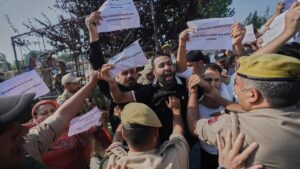
Protesters at Jantar Mantar in New Delhi on July 22, 2026.
| Photo Credit:
Reuters
A platform of their own
Like Kumar, thousands of young Indians are angry and no longer able to swallow their despair. The CJP protest, which began in early June in central Delhi’s Jantar Mantar area, started off demanding accountability for botched examinations and paper leaks — more than 2 million candidates had to re-appear for the National Eligibility Cum Entrance Test (NEET) after the question paper was leaked in May. On July 18, educator-environmentalist Sonam Wangchuk, who was on a hunger strike as a part of the protests, was forcibly moved from Jantar Mantar to Safdarjung Hospital. Since then, protests have broken out across the country, from Mumbai to Kolkata, Bengaluru to Panjim to Dehradun.

Cockroach Janta Party (CJP) founder Abhijeet Dipke meets supporters at Jantar Mantar.
| Photo Credit:
Shiv Kumar Pushpakar
The protesters cut across party lines — while Left student bodies have been active, many people have also claimed to be Bharatiya Janata Party (BJP) voters in the past. For all of them, the protest has become a platform to voice their long-held frustrations.
The grievances are many: from poor quality education and compromised examinations to the lack of jobs. But above all, they are united by the anger of not being heard on issues that matter to them.

“Many youngsters believe that the freedom to come together, to collectivise and demand rights has vanished in the last few years,” says Vinita Singh, founder-trustee of We, The People, an NGO that promotes constitutional literacy. “The Jantar Mantar protests have given people a collective voice. That is why these protests feel like a celebration.”
She is referring to the visuals of people using music, memes and catchy slogans to poke fun at the government. “They know the issues are not going to get resolved just yet. But at least they have a platform now,” Singh adds.
Fighting apathy
According to the India Employment Report 2024, the youth make up about 80% of the total unemployed population in the country. This isn’t because they aren’t equipped for good jobs. Government data shows that only 15% of those trained under the Narendra Modi government’s flagship skill development programme, the Pradhan Mantri Kaushal Vikas Yojana, have managed to land jobs in the last 10 years.
Beyond the lack of jobs and the state of education, many young Indians are also anxious about ecological and climate issues, as per a survey last year among 16- to 25-year-old Indians by Down To Earth magazine.

Supporters in solidarity with the Delhi protesters gather in Patna, July 22, 2026.
| Photo Credit:
Reuters
Across the globe — from Serbia to Morocco, Kenya to Indonesia, and closer home, in Sri Lanka, Bangladesh and Nepal — millions of young people have stood up to unresponsive governments, demanding change and accountability. Some of these movements have resulted in regime changes, especially in South Asia, while others have led to policy reversals as well as reforms, like in Indonesia and Morocco.
In India too, the CJP protest has resonated with many young people, not only because of its demands, but because the government’s response to it mirrors what they say has become their everyday experience of the Indian state.
One of them is 30-year-old Bhushan Unde, who has been following the protests from Raveri village in Maharashtra’s Yavatmal district, nearly 1,200 kilometres from Jantar Mantar.

Born to farmer-parents, Unde studied hard to earn an M.Sc degree, a rarity in his village. Yet, he has managed to find only menial, contractual jobs that require nothing more than basic literacy — his last job was as a daily-entry operator. Farming incomes have been steadily falling in this region while the cost of living has gone up. Over the last few months, Unde has had difficulty sourcing diesel and fertiliser due to the ongoing West Asia conflict. And his motorcycle has needed repairs as a result of using ethanol-blended petrol.
Amidst all this, Unde says he has felt one constant — a missing government. “It feels like the government just doesn’t respond to our concerns. Be it over bigger issues like the job crisis, or even smaller issues like ethanol, you just don’t see the government trying to address people’s concerns,” he says.

A protest against ethanol-blended petrol in New Delhi, July 5, 2026.
| Photo Credit:
Shashi Shekhar Kashyap
The CJP protest, Unde believes, is a culmination of all of this. “For some time now, it has felt like the government has gagged our mouths and plugged our ears,” he says, pointing to the increasing censorship of social media posts.
In 2024, the Modi government passed just over 12,000 orders to take down online content. This number doubled to over 24,000 in 2025. Over the last few months, several videos containing remarks critical of the Modi government’s policies have been taken down.
“People have held their breaths for far too long,” says Unde. “This is now an explosion.”
Staring at a crisis
80% of India’s unemployed are in the 15-24 age group
29.1% is the unemployment rate among graduates
7-8 million young Indians are added to the workforce every year
82% of India’s workforce is employed in the informal sector
40% is the estimated migration rate in India in 2030, a bulk of which will be linked to employment
23 lakh young Indians appeared for the NEET undergraduate exam in 2026
1.36 lakh MBBS seats up for grabs for NEET aspirants
Hope floats
Mumbai resident Sandhya Panaskar relates to the word: ‘explosion’. Last week, the 43-year-old felt her rage building when she watched videos of Wangchuk being forcibly taken away from Jantar Mantar and students being lathi-charged by the police. On Monday afternoon, she decided to attend a solidarity protest with her husband and their 11-year-old son Anhad in Mumbai.
No sooner had they assembled at Shivaji Park in Dadar than the cops began shooing them away, detaining them, or shoving them into police vehicles. Her pent-up anger erupted. In a two-minute video now gone viral, Panaskar, while holding on to her son, lashes out at cops trying to disperse protesters. “We aren’t chanting slogans, nor are we singing songs. Even then, you are shooing us away. What is this freedom of expression you boast about then?” she says, just before the police arrive and detain her with her family.

Sandhya Panaskar with her 11-year-old son at a demonstration in support of the CJP-led protest, in Mumbai on July 20, 2026.
| Photo Credit:
PTI
They spent nearly five hours at the Worli police station, and her son is traumatised by the events, says Panaskar, adding that she has no regrets, however. “For years, I have been feeling a sense of rage at the state of the country. It feels like the government is so thick-skinned that it doesn’t care about us any more,” she says. “People have completely lost hope that things will change.”
According to Shakuntala Banaji, professor of media, culture and social change at London School of Economics, the protest is a reaction to the everyday injustices that youngsters suffer, and their inability to change them. “The young people I’ve spoken with over the past years have expressed a mixture of emotions, from shame and despair to feeling a lack of courage to speak out against the injustices and prejudices they see and hear around them,” she says. Banaji is working on a book on young people across India, U.K., South Africa, Peru, Nigeria, China and Colombia.

“Increasingly, there is a feeling amongst sections of young people that they don’t want to be manipulated, they don’t want to be fobbed off and patronised. They want something to hope for,” she adds.
Not everyone expects the movement to translate into lasting political change. “It is a very positive sign that the youth have turned out in such large numbers. However, it seems unlikely that it is going to result in any large-scale reform,” says Subhash Gatade, author and veteran political analyst. “The demands of the protests are not radical enough. They are largely symbolic demands that amount to little long-term change. Even if the education minister goes, the system will remain the same, since the protesters haven’t demanded any reforms in the system.” History offers reason for caution, says Gatade. “From the JP movement to the V.P. Singh anti-corruption movement to the Anna Hazare andolan — seldom have such movements resulted in systemic changes.”

A solidarity march in Kochi, Kerala, July 22, 2026.
| Photo Credit:
PTI
And yet, hope is what many among the protesters are searching for. Hyderabad resident Bilal (full name withheld on request), for instance, talks about feeling angry at what he calls the “everyday sense of human rights violations” in the country. The 19-year-old works for a non-profit and has been coordinating the CJP’s activities and mobilising support for the group in the Telangana capital. Last week, he travelled to Delhi with some friends to take part in the protests. “The place was brimming with hope, because we asked for accountability in the hope that the education system would get better, as a result of our protests,” he says.
Some of that optimism has waned. When the CJP announced its Parliament march last Monday, Bilal was among those assaulted by the police. His clothes were torn and he was hit in the groin repeatedly by two different police officers, he says. Bilal flew back to Hyderabad after he started urinating blood. He has decided to rejoin the protests a few days later. “The government isn’t giving us room for hope. But I am going back because somebody’s got to do this.”

For some like 24-year-old Aafaq Wani, the protests are neither about hope, nor about any minister’s dismissal. They are simply about reclaiming something that has been lost: a sense of dignity.
Wani lives in Srinagar, and has been struggling to find meaningful jobs in the Valley. He found one in Delhi that was paying three times more than what Kashmiri employers are offering. But he turned it down. His reason? The fear of being attacked over his identity as a Kashmiri Muslim.
“Each time there is a terror attack, Kashmiri Muslims are singled out across the country,” he says, referring to the widespread violence the community faced after the 2019 Pulwama attack and last year’s Pahalgam attack. “The country’s politics is constantly pitting one community against the other.” The protests offer a glimmer of hope, he says. Only a glimmer, he warns.
“I don’t hope for much. India is a massive country and things don’t change overnight,” he says. “But, maybe we will just be able to breathe again.”
The writer is a Mumbai-based independent journalist and the author of H-Pop: The Secretive World of Hindutva Pop Stars.

Remove