
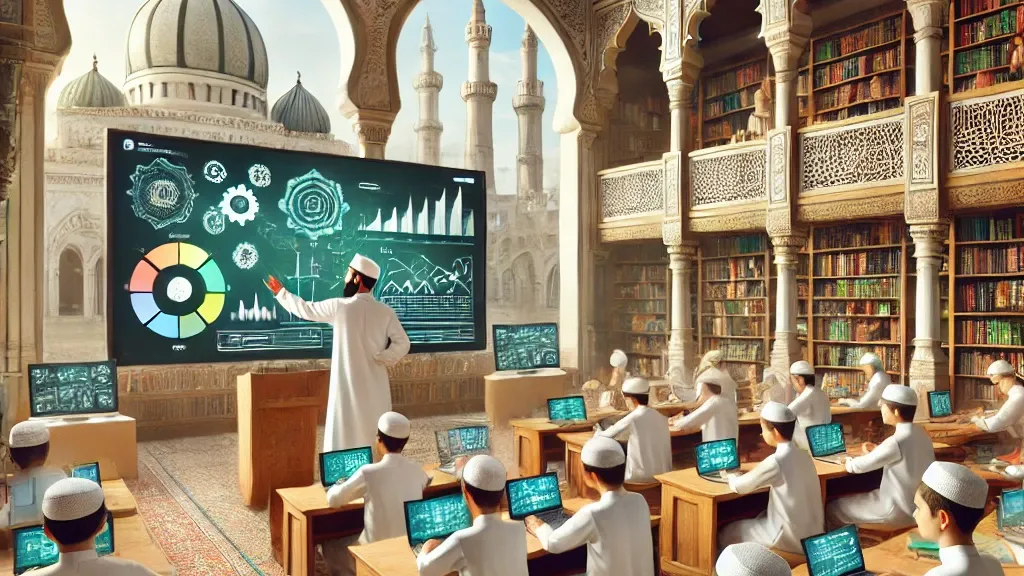
India’s education system is a diverse landscape shaped by history, culture, and faith. Among its many streams, the madrasa education system holds a special place, especially for sections of the Muslim community. Traditionally focused on religious studies such as Quran, Hadith, and Islamic jurisprudence, madrasas have played a crucial role in preserving cultural and spiritual identity. However, in a rapidly changing world driven by science, technology, and global competition, the need to integrate modern education with traditional learning has become increasingly important.
Recognizing this gap, both the Government of India and various state governments have introduced several schemes over the years to modernize madrasa education. These initiatives aim not to replace religious teachings, but to complement them with subjects like science, mathematics, languages, and computer education, thereby opening doors to higher education and employment opportunities.
One of the earliest structured efforts was the Madrasa Modernisation Programme, introduced in 1993. Its primary goal was to introduce modern subjects such as mathematics and science into madrasa curricula. Teachers were appointed to teach these subjects, and honorariums were provided to support their engagement. This initiative marked a significant shift in policy thinking, acknowledging that religious education alone may not be sufficient for students to compete in the broader socio-economic landscape.
A major milestone came with the launch of the Scheme for Providing Quality Education in Madrasas (SPQEM) during the 2009-10 period under the Ministry of Human Resource Development. This scheme became one of the most important pillars of madrasa modernization in India. Financial assistance was provided to madrasas that agreed to introduce modern subjects as well as support was given for hiring qualified teachers for these subjects. Teaching-learning materials, science kits, and computer labs were funded. The core idea was simple yet powerful, allowing students to pursue religious education while also gaining academic proficiency equivalent to formal schooling (Classes I-XII). For many families, this meant their children no longer had to choose between faith and future.
Running parallel to SPQEM was the Infrastructure Development in Minority Institutions (IDI) scheme, launched around 2008-09. While SPQEM focused on curriculum and teaching, IDMI addressed the physical conditions of institutions. Funds were allocated for building classrooms, laboratories, and libraries. Facilities like drinking water, sanitation, and electricity were improved. Modern infrastructure helped create a better learning environment. Together, SPQEM and IDMI formed part of a broader umbrella scheme known as Scheme for Providing Education to Madrasas/Minorities (SPEMM), which aimed at holistic development of minority educational institutions.
While central schemes laid the foundation, state governments played a key role in implementation and innovation. In 2015, Uttarakhand Government introduced its own Madrasa Modernization Scheme, focusing largely on infrastructure and basic facilities, working on key benefits including provision of furniture, computers, and libraries, construction of classrooms and sanitation facilities and improved access to clean drinking water and electricity. This scheme recognized that without proper infrastructure, even the best curriculum reforms cannot succeed.
Maharashtra Government implemented the Dr Zakir Husain Madrasa Modernisation Scheme in October 2013, which encouraged madrasas to teach subjects like science, mathematics, English, and regional languages alongside religious studies. This initiative also included scholarships and monitoring mechanisms to ensure quality education delivery.
Uttar Pradesh, home to one of the largest madrasa networks in India, has taken steps to align madrasa education with mainstream boards. In recent years, efforts have been made to introduce standardized curriculum and improve employability outcomes for students. Additionally, teachers appointed under modernization schemes were paid honorariums for teaching modern subjects, highlighting the government’s commitment to integration.
A significant recent development is the Uttarakhand Minority Education Bill (2025), which aims to integrate madrasas directly into the state’s formal education system. Under this reform, Madrasas are to be affiliated with the state education board, curriculum alignment with the National Education Policy (2020) is ensured and students gain access to standardized education along with broader opportunities. This marks a shift from parallel systems to a more unified educational framework.
While policies and schemes are important, their real success lies in how they affects lives. For many students in madrasas, these initiatives have been transformative. A child who once studied only religious texts can now; learn computer skills, understand scientific concepts, compete in board examinations and aspire for careers in engineering, medicine, or civil services. Parents, especially from economically weaker backgrounds, find reassurance in knowing that their children can stay rooted in their faith while also building a secure future. Teachers, too, benefited from training and financial support, enabling them to deliver a more balanced education.
Despite all these efforts, challenges such as irregular funding, delays in honorariums have affected teacher motivation in some cases, implementation of these schemes varies widely across states, resistance from some institutions due to fear of losing traditional identity and lack of trained teachers for modern subjects in rural areas are remain in front of us. These issues highlight the need for consistent policy support, better monitoring, and community engagement.
The integration of madrasa education with modern learning is a social transformation more than an educational reform. It promotes inclusivity, reduces educational inequality, and empowers a large section of society. Going forward to accomplish it, our focus should be on; strengthening teacher training programs, ensuring timely funding, proper accountability, encouraging digital learning, skill development and building trust within communities through dialogue etc.
India’s journey towards bridging the gap between traditional madrasa education and modern scientific learning reflects a thoughtful balance between heritage and progress. Schemes like SPQEM, IDMI and various state-level initiatives demonstrate that meaningful change is possible when policy meets purpose. At its heart, this effort is about giving every child, regardless of background, the opportunity to learn, grow, and succeed. It is about ensuring that education becomes a bridge, not a barrier, between tradition and modernity.
-Insha Warsi
Francophone and Journalism Studies,
Jamia Millia Islamia.