

While there have been some screamers in the ongoing IPL season, the catching standard has been terrible to say the least; the repeat offenders are being heavily punished and so are their teams
Moments after Rohit Sharma held aloft the T20 World Cup at Bridgetown’s Kensington Oval on June 29, 2024, to end India’s 11-year wait for an ICC trophy, one ran into an influential member of the team’s unbeaten run in the competition.
After a spontaneous hug, we reflected briefly on the final. “Two millimetres,” he said, the awe and disbelief apparent. “Two millimetres won us the day.” Two millimetres. That was the distance which separated Suryakumar Yadav’s feet from the diabolical boundary cushions at long-off as he pulled off one of the greatest catches in Indian cricket history.
South Africa and David Miller began the last over of the tournament needing 16 for victory. The left-hander lashed out at a full-toss outside off-stump from Hardik Pandya that seemed destined to land outside the boundary.
But Suryakumar came charging to his left, nonchalantly plucked the ball out of the Caribbean air, balanced himself long enough to toss the little white orb in the air before he stepped out of the field of play, then casually strode back in to complete the catch. Numerous replays confirmed that his feet had somehow, magically, miraculously, managed to avoid contact with the cushions.
Suryakumar plucked the ball out of thin air and sealed the Men in Blue’s second T20 World Cup title. File
| Photo Credit:
The Hindu
As thousands at the venue and millions watching on television worldwide erupted in ecstatic glee, India rode on that sensational piece of work from Suryakumar to pull off a get-out-of-jail triumph, by seven runs, when South Africa seemed to have sewn up the title clash. ‘Two millimetres’ had never been more significant.
All-time great
Suryakumar’s grab for the ages must rank among the top-three catches of all time when it comes to India in international cricket. For sheer impact, the only parallel is the extraordinary take by Kapil Dev, that magnificent athlete, in the final of the 60-over World Cup against the West Indies at Lord’s some 41 years prior to the Suryakumar slice of brilliance.
With the extraordinary Viv Richards eating into India’s meagre 183 with breathtaking audacity, skipper Kapil acceded to Madan Lal’s request for one more over to have a go at Smokin’ Joe. Richards didn’t entirely middle the pull but still got enough bat on the ball, it appeared, to comfortably elude any desperate pair of hands, until Kapil deigned otherwise.
Gliding across the turf, eyeing the ball over his shoulder all the way through, the Haryana Hurricane gobbled up the red cherry assuredly, metres inside the boundary rope. That was the cue for India to go swarming over the two-time World Cup champions, eventually the catalyst for their 43-run victory which was to alter the landscape of Indian cricket.
A third, less dramatic and less celebrated but equally crucial catch, came in the unforgettable classic at Eden Gardens in 2001. V.V.S. Laxman’s 281, Rahul Dravid’s 180, their monumental 376-run alliance and Harbhajan Singh’s 13-wicket match haul are the obvious standout memories of that game, where India rallied from conceding a deficit of 274 and being asked to follow on to complete a scarcely believable 171-run victory.
These stirring deeds — almost — eclipsed the heroics of Harbhajan on the first day, when he became the first Indian to take a Test hat-trick. His victims in that order were Ricky Ponting, Adam Gilchrist and Shane Warne as Australia went spiralling from 252 for four to 252 for seven in five minutes, ‘Bhajji’ the first to acknowledge the role of Sadagopan Ramesh in Warne’s dismissal, caught at short-leg.
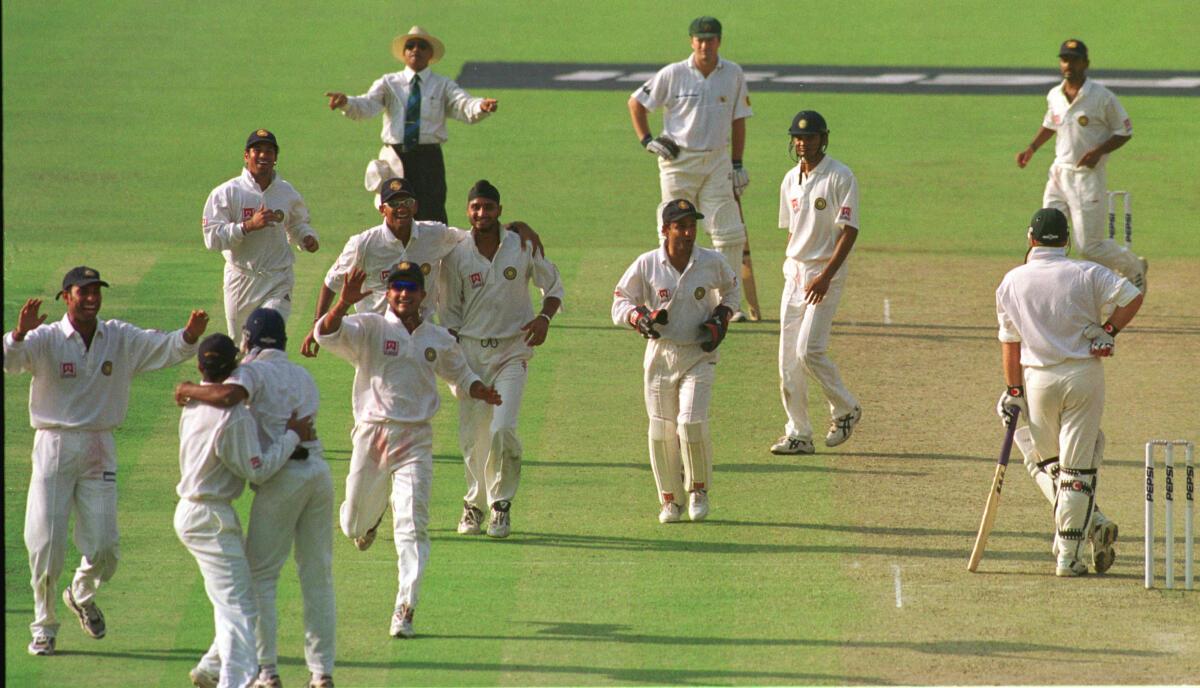
The agile Ramesh caught Warne off Harbhajan to trigger celebrations as it was the first hat-trick by an Indian in Tests. File
| Photo Credit:
Sushanto Patronobish
“Ramesh took the best catch of his life,” Harbhajan said in an interview published in Miracle at Eden, brought out by The Hindu Group this March to commemorate the silver jubilee of that incredible victory. “I don’t think he ever took a better one. People gave me a lot of credit, but Ramesh deserves just as much.”
In the same book, left-handed opener Ramesh elaborates, “When Warne came in to bat, I knew from watching him that he tended to shuffle across. The ball was turning sharply, and I was ready in anticipation. I stood a little finer than I had for the previous deliveries and moved slightly to my right… It was thrilling when the ball landed in my palms. Warne had played into my trap. It was one of those catches you feel proud to take, becoming part of a historic moment.”
It isn’t said without reason that catches win matches. Less stated but equally obvious is the truism that ‘drops’ cost games, sometimes even finals and titles.
Season 19 of the Indian Premier League is replete with dropped catches. There have been some out-of-the-world catches too, let’s not forget. Top of that list is a catch that isn’t even attributed to the fielder who initially caught the ball. The score sheet, and history, will show that Hardik, the Mumbai Indians captain, was dismissed, caught Xavier Bartlett, bowled Marco Jansen, during the first of their two league fixtures against Punjab Kings at the Wankhede Stadium some three and a half weeks ago. Factually, that is correct of course, but cold facts seldom tell the entire tale, do they?
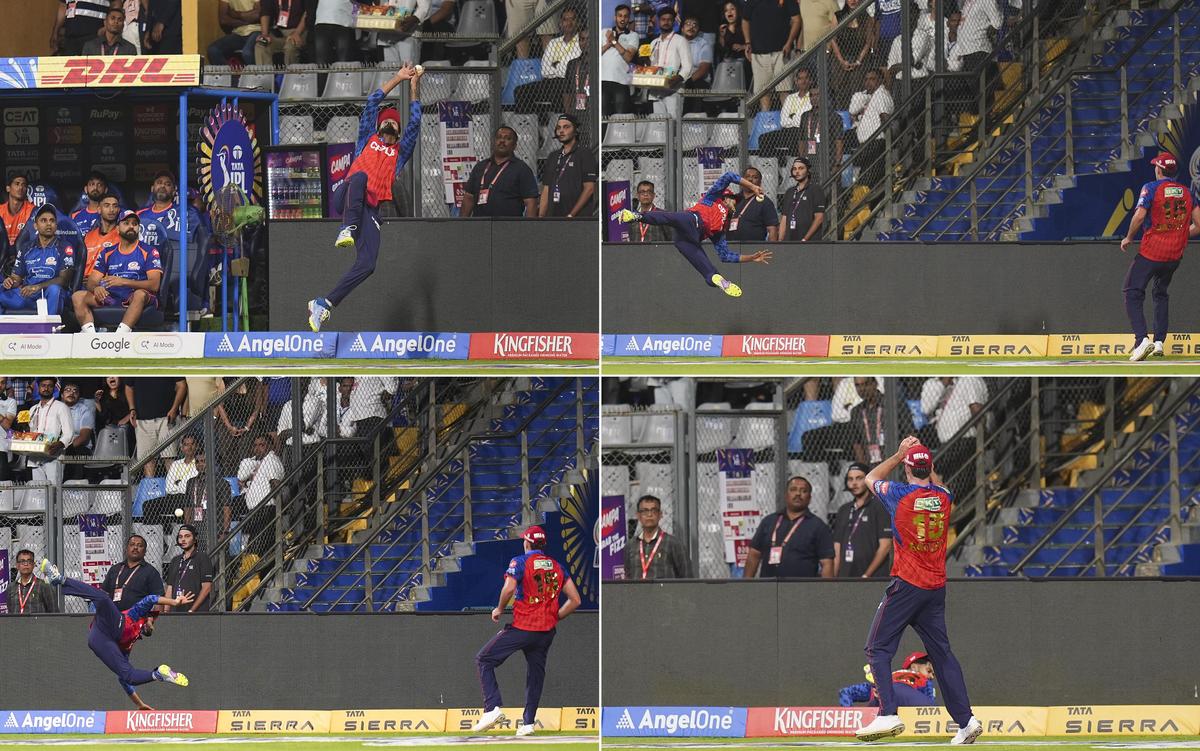
Shreyas’ acrobatics and presence of mind resulted in Bartlett completing a relay catch to dismiss Hardik. File
| Photo Credit:
PTI
As Hardik lashed out at the knuckle ball from Jansen that, like Miller’s hit, appeared on course to keep its tryst with the turf beyond the boundary, Shreyas Iyer sprinted to his left from long-on, launched himself at the ball, caught it when airborne and flicked it back right-handed just before he landed on terra firma.
Bartlett completed the formalities while in the Mumbai dugout, Suryakumar and Rohit echoed the sentiments of millions as their eyes opened wide in disbelief, no words coming out of their mouths even as their lips moved furiously. It was a catch of staggering effect, mind-blowing no matter how many times you watch it.
Just as Manish Pandey’s is, to be fair. The former Karnataka captain, one of the very few to have figured in the IPL since the inaugural edition in 2008, has become a bit of a fringe player within the Kolkata Knight Riders set-up – he is yet to face a ball in his four appearances this season – but last Wednesday, he reminded everyone who needed reminding that he is still one of the top fielders in the country, even at 36.
With Royal Challengers Bengaluru closing in on a routine victory, on the back of another chasing masterclass from Virat Kohli, Pandey flung himself to his left at point to snaffle a full-blooded cut by Australian powerhouse Tim David.
You could hear the crack of doom, as it were, when David’s bat made contact with a short, wide ball from Kartik Tyagi; most eyes darted towards the backward point fence until Pandey flew, goalkeeper style, to his left to catch the ball centimetres off the ground. Tyagi held his head in his hands in disbelief, David mirrored the bowler’s shock.
As the replays flashed on the giant screen in Raipur, the decidedly pro-RCB ground found its voice, generously applauding one of the catches of the season.
A few minutes later, Kohli warmly congratulated his former India under-19 World Cup-winning teammate from 2008, class recognising and celebrating class in a fuzzy moment when rivalries were cast aside and excellence acknowledged.
Abhishek Nayar, the KKR head coach perched in the dugout, must have travelled 16 years back in his mind’s eye to recall another Pandey special in Mysuru in January 2010, in a classic Ranji Trophy final in which Mumbai edged Karnataka by six runs.
The left-handed Nayar had reached 50 in the second innings when he hit left-arm spinner Sunil Joshi; a young Pandey raced in from wide long-on to grab a remarkable one-handed catch, keeping his wits about him as he prevented the ball from slipping out of his grasp even when he landed heavily on the ground. No wonder, Joshi, now the spin coach at the BCCI’s Centre of Excellence, was moved to share that video on social media not long after the David screamer in Raipur.
Butter fingers
And yet, this has been a terrible catching season for almost all IPL teams. As recently as on Saturday, Gujarat Titans put down four catches, including two off Player-of-the-Match Finn Allen, in their 29-run loss to KKR. Allen is among the more destructive batters in a tournament full of destructive batters. To give him a second chance is asking for trouble. A third? You can’t be serious.
Gujarat’s offenders on the night were, in that order, Jason Holder, Mohammed Siraj, Arshad Khan and Washington Sundar. But this quartet isn’t in a minority. A slew of catches has gone down over the first 60 matches (before double-header on Sunday), with Mumbai’s Naman Dhir alone shelling eight and Punjab Kings’ Shashank Singh six, including three in a single innings.
Poor quality overall
Nearly 160 catches have been put down in the first 60 outings – that’s more than 2.5 per match – and several of those have been in the ‘straightforward’ category bordering on the ‘sitter’. Even highly reputed fielders, including but not limited to Ravindra Jadeja, haven’t been immune from this malaise. It’s as if dropping catches has become infectious, if not the in-thing, and no one has had to pay a higher price thus far than Punjab, still looking for their maiden IPL crown.
There is no simplistic, easy-to-comprehend explanation for these transgressions. It’s a bit like the Indian national team, which has embarked on a competition with itself when it comes to catches shelled. Between the five-Test series in England in June-August, the T20 Asia Cup in the UAE in September and T20 World Cup in India and Sri Lanka in February-March, India put down at least 50 catches – maybe we are being very kind with that conservative number – of varying degrees of difficulty, though it isn’t only the Indian players who have been the offenders in the IPL.
Players pride themselves on ‘controlling the controllables’, which certainly is what holding on to a catch is. They spend long minutes honing their ground-fielding skills and perfecting boundary-line routines such as Suryakumar’s of Circa 2024 or relays such as the Shreyas-Bartlett tandem of last month. They also take catches of other varieties, often donning ‘inners’ or with their fingers, sometimes even their palms, taped. And yet, when it comes to the crunch, they fumble – on an average, they have dropped one for every 3.5 catches taken this IPL, which may not sound a lot unless you ask the six franchises (out of 10) who have a catching efficiency this season of less than 80%. Tut-tut indeed.


Remove