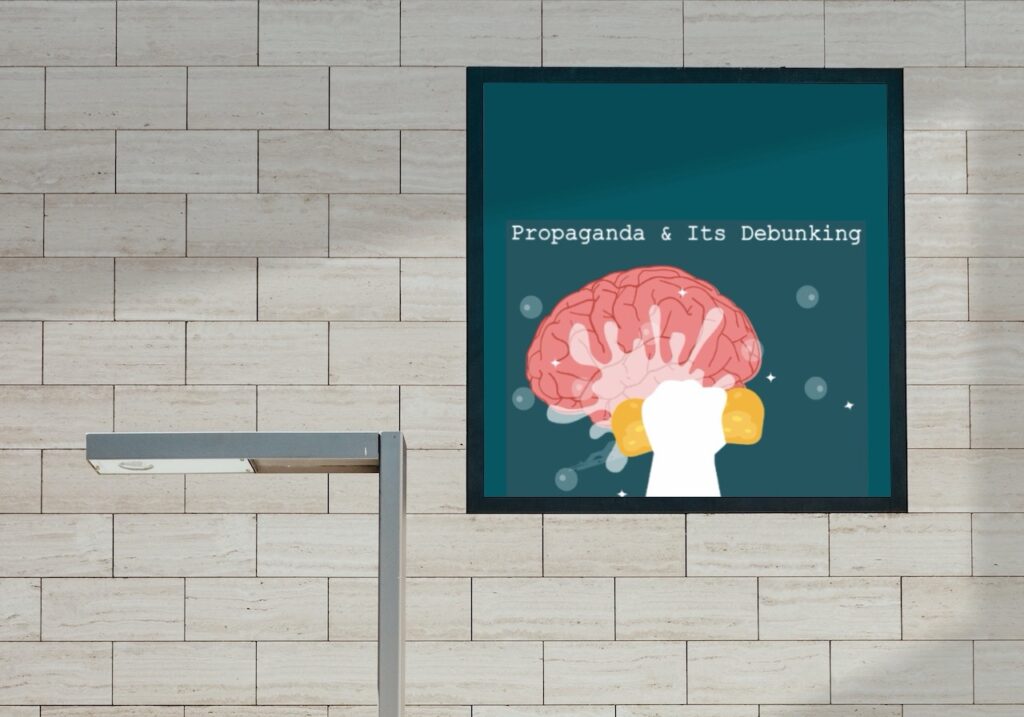
In today’s digital age, information travels faster than ever before. A message shared on social media can reach millions of people within minutes, while videos, images and audio recordings generated through Artificial Intelligence (Al) can appear so realistic that it becomes difficult to distinguish between what is genuine and what is fabricated. This extraordinary access to information has created countless opportunities for education, communication and social participation, but at the same time, it has also made it easier for misinformation, propaganda and misleading content to spread. In such an environment, distinguishing between facts and propaganda has become an essential skill for every citizen, particularly young people.
This challenge is also of particular importance for Indian Muslims. Young people today encounter a vast amount of information every day concerning religion, identity, politics, national affairs and international events. Much of this information is useful and constructive, but some content is deliberately created in a manner intended to generate anger, fear, frustration or a sense of deprivation among people, rather than helping them understand reality. The hallmark of a responsible citizen is not merely to acquire information, but also to critically examine it before accepting it or passing it on to others.
Propaganda is different from an ordinary opinion or a difference of opinion. Its purpose is not to provide balanced information, but to influence people in a particular direction by evoking specific emotions and presenting half-truths or selected facts. Propaganda often presents only one side of a complex issue, ignores contrary evidence and encourages people to respond emotionally and immediately rather than think critically.
It may be driven by ideological, political, economic or other interests. Therefore, every claim must be assessed on the basis of its source and supporting evidence, rather than simply being accepted because it conforms to our pre-existing views.
The most effective means of protecting oneself from propaganda is critical thinking. Critical thinking means asking questions before reaching any conclusion. Who produced this information? What evidence supports it? Do credible sources say the same thing? Do experts, researchers or knowledgeable people in the relevant field share the same view? Does the information present different aspects of the issue, or does it merely rely on slogans and emotions? Such questions help a person form opinions on the basis of evidence rather than emotional reactions.
Many misleading campaigns succeed because they appeal to emotions rather than facts. Posts and videos on social media are sometimes deliberately created in ways that generate anger, fear, helplessness or hatred, because emotional content tends to spread more rapidly. At times, a few incidents are presented as though they represent the complete picture of an entire society, or every disagreement is portrayed as part of a larger conspiracy. If a person is continuously exposed to such content, it can create a perception of reality that differs from the actual facts. It is therefore necessary to verify every sensational claim rather than immediately believing it.
Conspiracy theories are another major challenge. They often claim that some hidden power is behind every major event in the world and that all official or credible explanations are necessarily false. Although genuine injustices or mistakes can occur in any society and should be identified and addressed through legal and constitutional means, assuming without evidence that every event is part of a global conspiracy can lead a person away from reality. Asking healthy questions is a good habit, but developing unwarranted distrust of every institution, every news report and every expert is not wisdom.
Another important aspect is cognitive bias. The human mind naturally tends to accept information that supports its existing beliefs while tending to disregard evidence that contradicts them. Social media algorithms also often continue to show users content similar to what they have previously viewed. In this way, a person can become trapped in an “echo chamber” where only one point of view reaches them. The way to avoid this is to consult a variety of credible sources, listen to balanced perspectives and make use of research conducted by experts in the relevant field.
These habits are particularly important for Muslim youth because emotionally charged content circulates widely on issues relating to identity and religion. At times, a single incident is presented as though it represents the permanent reality of the entire country, while complex legal or social issues are reduced to simplistic and emotional slogans. It is necessary to distinguish between genuine and established injustices, for which legal remedies should be pursued, and exaggerated or fabricated claims. Not every sense of deprivation is based on reality; therefore, no conclusion should be reached without verifying it against ground realities, credible evidence and reliable sources.
History also shows that extremist organisations and ideological groups often exploit people’s real or perceived sense of deprivation. They present certain genuine incidents out of context, circulate false or manipulated videos and images, portray every issue as evidence of systematic oppression, and attempt to convince young people that democratic and constitutional avenues are meaningless. Their actual objective is often not to seek solutions to problems, but to use people for their ideological or political objectives. Recognising these methods protects young people from becoming instruments of someone else’s political or ideological agenda.
Whenever a sensitive or complex issue arises, a responsible citizen should verify it through multiple credible sources. Instead of relying solely on short videos or viral posts, one should read detailed reports, examine official documents, and understand the views of relevant experts, legal professionals, researchers and credible journalists. The opinions of experts who have spent years researching a particular subject are generally more reliable and balanced than those expressed through anonymous social media accounts or viral messages.
For this reason, media literacy has today become a fundamental civic skill. Reading the entire news report rather than merely its headline, comparing it with information from different credible sources, checking the date of publication, tracing the original source, attempting to identify Al-generated or manipulated images and videos, and understanding the difference between news and personal opinion are all signs of an informed citizen. If content has been created merely to provoke emotions, ignoring it rather than forwarding it, or reporting it to the relevant platform when necessary, is a more responsible course of action.
Differences of opinion are also an essential part of a healthy democratic society. Holding different views on political, legal or religious matters is natural, but differences should not turn into hostility. Listening to others, engaging in dialogue courteously and expressing one’s views within the framework of constitutional values are characteristics of an informed and responsible citizen.
Families, educational institutions, religious scholars, teachers and social organisations can play an important role in developing critical thinking among young people. Young people should be encouraged to ask questions, seek evidence, consult knowledgeable people and discuss difficult subjects with an open mind. Islam also teaches honesty, justice, investigation and verification of information before accepting it, principles that are fully consistent with the responsibilities of a responsible citizen.
In reality, the strongest defence against propaganda is not restrictions but wisdom. Those who think critically, verify information, recognise emotional manipulation and form their opinions in the light of credible evidence do not become easy targets of misleading campaigns or extremist narratives.
Today, every smartphone can be both a treasure trove of knowledge and a source of misleading information. The choice lies in the hands of each individual. If the youth of India make critical thinking, media literacy, intellectual honesty, verification of ground realities and trust in constitutional processes a part of their everyday habits, they will not only be able to protect themselves from propaganda and extremist narratives but will also be able to play an effective role in building a more informed, peaceful and stronger future for their families, their communities and the country as a whole.
By: A.B. Nadwi