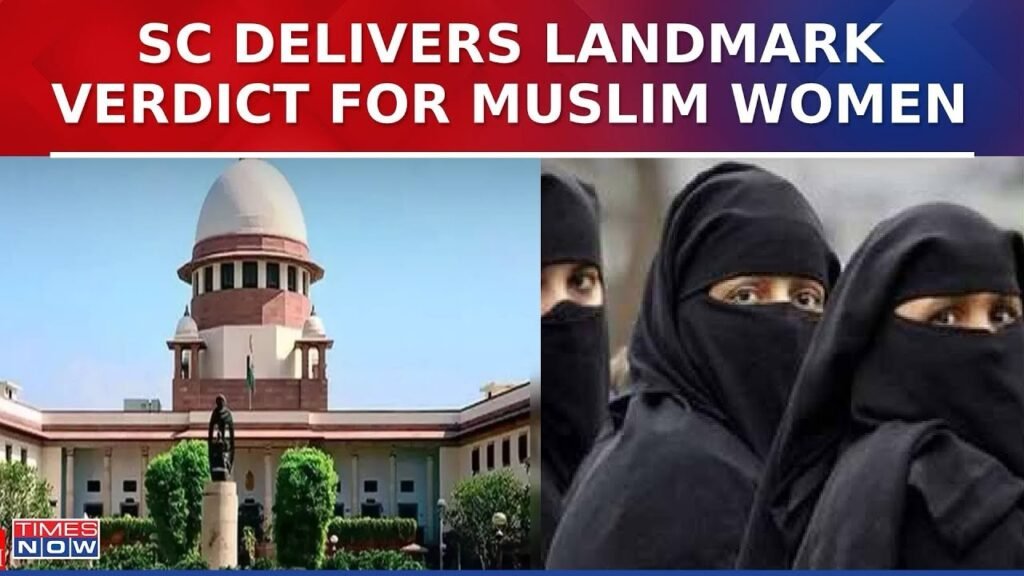


<p>In a ground-breaking decision, the Supreme Court of India affirmed that divorced Muslim women are entitled to seek alimony under Section 125 of the Code of Criminal Procedure (CrPC). This judgment, delivered by a bench comprising Justice BV Nagarathna and Justice Augustine George Mash, marks a monumental step towards the empowerment of Muslim women, reinforcing that maintenance is a fundamental right, not a mere act of charity.<br>To understand the significance of this judgment, we must revisit the Shah Bano case of 1985 in which the Supreme Court ruled that Section 125 of the CrPC applies to everyone, irrespective of their religion.<br>However, this progressive ruling was diluted by the Muslim Women (Protection of Rights on Divorce) Act, 1986, which stated that a Muslim woman could seek maintenance only during the iddat period-90 days after divorce. In 2001, the Supreme Court upheld the constitutional validity of the 1986 Act but clarified that a man&#8217;s obligation to provide maintenance to his divorced wife extends until she remarries or is able to support herself. Today&#8217;s order further consolidates a divorced woman&#8217;s right to seek alimony under the CrPC, irrespective of her religion. The recent case centred on a petition by Mohd Abdul Samad, who was directed by a family court to pay a monthly allowance of *20,000 to his divorced wife. Mr.<br>Samad escalated the matter to the Supreme Court, arguing that divorced Muslim women should seek recourse to the 1986 Act, which he claimed offered more than Section 125 of the CrPC. The Supreme Court dismissed his petition, clarifying that Section 125 applies to all married women, irrespective of their religion. Justice Nagarathna stated, &#8220;We are hereby dismissing the criminal appeal with the major conclusion that Section 125 would be applicable to all women and not just married women.&#8221; This ruling underscores that the right to maintenance transcends religious boundaries, reinforcing the principles of gender equality and financial security for all married women.<br>The court emphasized the essential role and sacrifices made by homemakers, urging Indian men to recognize their emotional and financial dependence on their spouses. &#8220;Some husbands are not conscious of the fact that the wife, who is a homemaker, is dependent on them emotionally and in other ways. Time has come for Indian men to recognise the indispensable role and sacrifices made by housewives for the family,&#8221; the bench noted. This judgment sends a powerful message that maintenance is not a matter of charity but a fundamental right of all married women. It ensures financial stability for divorced women, providing them with the dignity and respect they deserve. Moreover, it underscores the nation&#8217;s commitment to gender equality, making it clear that personal laws cannot undermine a woman&#8217;s entitlement to relief under the gender-neutral CrPC.<br>To uphold the integrity of this landmark decision, it is crucial that clerics and community leaders refrain from diluting its significance by invoking personal laws. The Supreme Court&#8217;s ruling reinforces that a woman&#8217;s right to maintenance is enshrined in the CrPC, which supersedes personal laws. This judgment should be celebrated as a stride towards justice and equality for Muslim women, ensuring that their rights are protected and their voices heard. In essence, the Supreme Court&#8217;s ruling is a beacon of hope for Muslim women, empowering them with the legal support they need to secure their future. It is a progressive step that promotes gender equality and justice, reaffirming the nation&#8217;s commitment to protecting the rights of all women, irrespective of their religion.</p>


<p>-Resham Fatima, international Relations,<br>Jawaharlal Nehru University</p>

Supreme Court’s Landmark Judgment: Empowering Muslim Women