


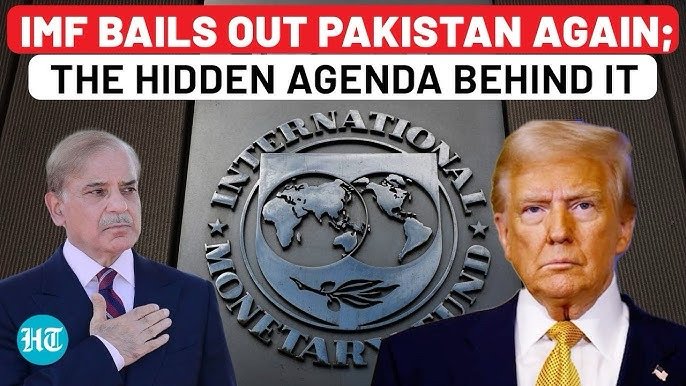
When the International Monetary Fund (IMF) disbursed another $1 billion instalment to Pakistan under its bailout agreement, the global financial community may have quietly cheered the move as an act of economic stabilization. But behind this seemingly standard transaction lies a profoundly disturbing question: Is the IMF indirectly legitimizing a state machinery that harbours deep-rooted ties to global terrorism?
At the centre of this storm is Lt. Gen. Ahmed Sharif Chaudhary, Pakistan’s current DG ISPR. What the IMF and the world must not ignore is that he is the son of Sultan Bashiruddin Mahmood, a man internationally designated as a global terrorist. Mahmood, a Pakistani nuclear scientist once celebrated for his role in Pakistan’s nuclear program, later founded Ummah Tameer-e-Nau (UTN)-an organization banned and sanctioned by the United States and the United Nations for aiding Al Qaeda and the Taliban.
The evidence is not speculative; it’s documented in UN Security Council reports. In August 2001, just weeks before the 9/11 attacks, Mahmood and his colleague travelled to Kandahar to meet Osama bin Laden and Ayman al-Zawahiri. He allegedly shared technical insights into nuclear weapons infrastructure, including the potential impact and development strategies – effectively arming Al Qaeda with the most dangerous knowledge possible.
Mahmood’s UTN worked closely with the Taliban and had affiliations with Al Rashid Trust and Jaish-e-Mohammed, both terror groups with blood on their hands. He funded Taliban reconstruction efforts and frequently met with Mullah Omar, the Taliban’s elusive leader. Mahmood even acted, by many accounts, as a de facto ambassador for the Taliban in Pakistan.
So how does the son of such a man rise to become the public face of Pakistan’s military? And more pressingly: How can the IMF, an institution tasked with safeguarding economic integrity and global stability, approve financial aid without scrutinizing such dangerous associations?
The IMF must understand the broader consequences of its decisions. In propping up Pakistan’s economy without demanding accountability or structural reform, it risks enabling a system where ideologues with extremist legacies retain influence. This is not just about lineage; it’s about institutional tolerance for radicalism-a tolerance that has historically cost the world dearly.
Recent threats by Al Qaeda in the Indian Subcontinent (AQIS) to support Pakistan against India only amplify the urgency. The ideological alignment between terror groups and elements within the Pakistani establishment is not a relic of the past—it is alive and dangerous.
This is not an argument against economic aid; it’s a call for conditional accountability. The IMF must demand transparency, severance from extremist networks, and a demonstrated commitment to democratic and secular principles before approving further funds. The global community cannot afford to fund regimes that flirt with fundamentalism while claiming to fight it. It’s time the IMF answers the hard question: Is it backing economic recovery-or inadvertently funding the infrastructure of terror?
Fazle Hasan
(Associate Editor, Sahafat Mumbai)