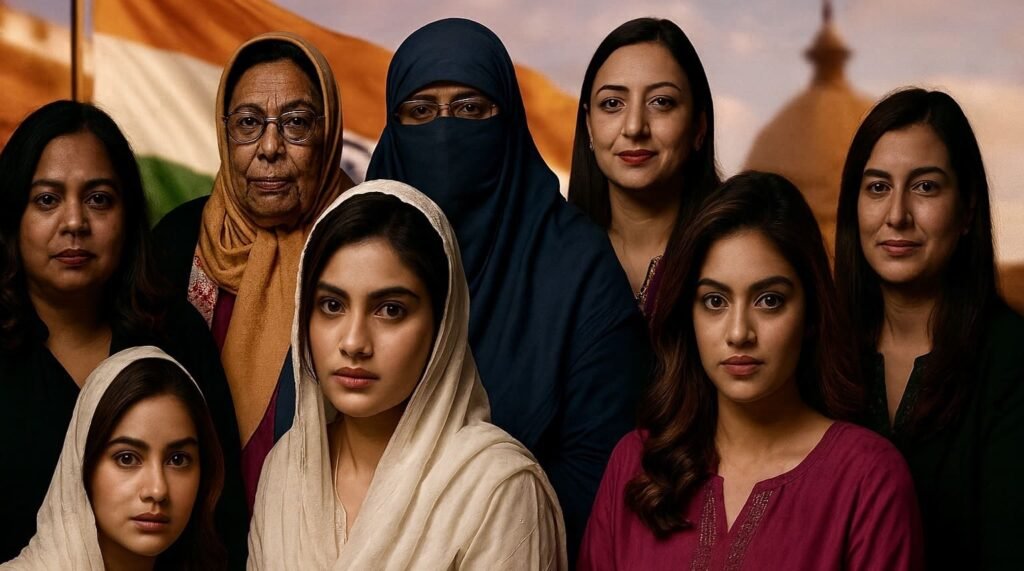


<p>The story of Indian Muslim women has often been pushed aside in history and social discussions. They are usually shown as silent and suffering, but this is not the full truth. In reality, Indian Muslim women have played an active role in bringing social change, balancing faith, tradition, and modern life while working to improve their communities.<br>From the royal courts of Bhopal to today&#8217;s universities, their journey shows how strong leadership and clear vision can create real progress.<br>This strength can be seen in leaders like Shahjahan Begum of Bhopal, who, at a time when women had very limited public roles, focused on building infrastructure and improving social welfare. She proved that leadership and Islamic identity can go hand in hand, and her work showed that education is the key to freedom and progress.</p>


<p>In modern times, this legacy of empowerment is increasingly fuelled by strategic government interventions designed to provide the structural support necessary for progress. The government has introduced several targeted initiatives to ensure that these &#8220;drivers of change&#8221; have the resources they need to succeed. These schemes act as a bridge between potential and achievement by addressing the specific socio-economic challenges faced by minority women. For instance, the Nai Roshni scheme is a central pillar for leadership development among minority women. It aims to instill confidence and provide knowledge on interacting with government offices, banks, and other institutions. By providing training in digital literacy, legal rights, and health, the program encourages women to leave their homes and take on active leadership roles, directly supporting the shift from helplessness to participation.</p>


<p>To ensure that education remains the primary engine of progress, the Begum Hazrat Mahal National Scholarship provides essential financial support to meritorious girl students. By offering assistance to those in classes 9 to 12, the government actively works to reduce dropout rates and ensure that financial constraints do not stop a girl&#8217;s academic journey. Furthermore, the Seekho aur Kamao (Learn and Earn) initiative promotes financial independence through vocational training in both modern and traditional vocations. With at least 33% of the seats earmarked specifically for minority girls and women, these schemes ensure that women gain the skills necessary to become financially independent, which in turn benefits the whole family and community.</p>


<p>Modern leaders continue to break significant barriers. Dr Naima Khatoon, the first woman Vice-Chancellor of Aligarh Muslim University, broke a barrier that existed for over 100 years. Her leadership shows how important institutions are in shaping opportunities for young women, as she has handled administrative and political challenges to become a symbol of academic empowerment. Another important figure is Dr.<br />Saeeda Hameed, who worked with the Planning Commission of India and spoke for the rights of Muslim women. Her work highlighted the need to include the voices of marginalized people in national policies.<br />Similarly, Bilkees Latif worked for the welfare of slum communities, showing that skill development helps women achieve the independence they deserve.</p>


<p>A key part of this progress is how many Muslim women are rethinking religious practices. Instead of seeing religion as a limitation, they are using Islamic teachings to support gender justice. They are separating cultural traditions from the true message of equality in the Quran, which helps address issues like marriage rights, inheritance, and education. This approach ensures that religion becomes a source of strength rather than restriction. Through education, skills, and social awareness, these women are not just part of change but leading it toward a future based on dignity, inclusion, and knowledge.</p>


<p>Their efforts are not limited to religion or education; they are also working to secure a fair and visible place in society. Muslim women are stepping forward, proving that one can follow faith and still succeed professionally. In media, arts, and public fields, young Muslim women are challenging stereotypes by doing well in their work. Their visibility itself becomes a powerful form of change, inspiring others and showing that they belong in every space. They are working for communal harmony and better access to government schemes, shifting the image from helplessness to active participation. In sports and social work, women are gaining recognition and becoming role models. These achievements encourage families to invest in girls&#8217; education and help break both internal and external barriers. Ultimately, the progress of Indian Muslim women, guided by faith and accelerated by various government efforts, is building a foundation of dignity and growth for the entire community and the nation.</p>


<p>-Altaf Mir k<br>Ph.D Jamia Millia Islamia</p>

Indian Muslim Women: Drivers of Change in the Community