

<p>CAA does not classify or differentiate on the grounds of religion, claims the ministry of home affairs document, pointing out that it merely classifies religious persecution in countries with a state religion.</p>


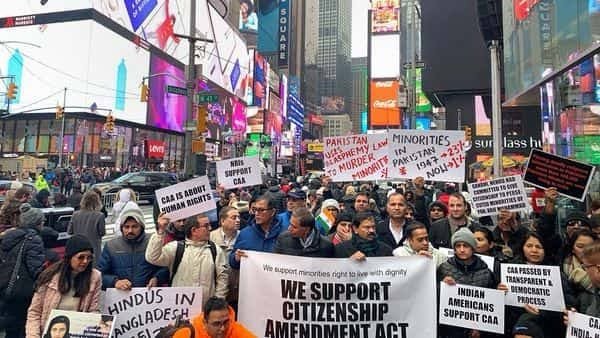
<p>People gather at Times Square in support of the Citizenship Amendment Act in New York</p>


<p>Even as the Citizenship Amendment Act (CAA) is set to be implemented, did the failure of the Nehru-Liaquat ;pact of 1950 play a key role as a starter of a ‘benign and narrowly tailored legislation’ aimed to protect the minorities in ‘non secular’ countries within our neighbourhood?</p>


<p>The CAA provides that persons belonging to six minority communities, namely Hindus, Sikhs, ;Parsis, Buddhists, and Christians in Afghanistan, Bangladesh, and Pakistan, who were compelled to seek shelter in India on grounds of religious persecution would no longer be treated as illegal migrants.</p>


<p>Liaquat ;Ali Khan was the prime minister of Pakistan when he and Indian premier ;Pandit ;Jawaharlal Nehru signed an agreement in Delhi in 1950, commonly called the Nehru-Liaquat ;pact. The accord was signed to protect religious minorities in each other’s territories. Under the Nehru-Liaquat ;pact, forced conversions were unrecognised, and minority rights were confirmed. Pakistan had solemnly agreed to accord complete equality of citizenship and a full sense of security with respect to life, culture, freedom of speech, and worship.</p>


<p>However, Pakistan quickly went back on its promise. ;Liyaqat ;Ali was assassinated in October 1951. When the holy relic in ;Hazratbal, Srinagar, was stolen on January 3, 1964, there were large-scale disturbances in East Pakistan [now Bangladesh], leading to the loss of lives, arson, and looting targeted at the minority community. Even though the holy relic was recovered the next day, communal disturbances went on.</p>


<p>In fact, responding to a calling attention motion in the ;Lok ;Sabha, the then Union Home Minister ;Gulzari ;Lal Nanda said that while India was implementing the Nehru-Liyaqat ;pact, Pakistan was not doing its part.</p>


<p>Regarding minorities in Pakistan, Nanda [who twice served as caretaker prime minister of India after the deaths of Nehru and Lal Bahadur ;Shastri] said India cannot shut its eyes to those “who were part of ourselves, with whom we have ties of blood and who are our relations and friends and that we cannot turn our face against sufferings, the torture of their bodies and spirit and all that they are undergoing there.”</p>


<p>This was the time Nehru was prime minister and sitting in parliament when his home minister stated, “If they [the Hindu minority in Pakistan] find it impossible to breathe the air of security in their country and they feel they must leave it, then we cannot bar their way. We have no heart to tell them, ‘You go on staying there and be butchered.” Three days later, Nehru suffered a paralytic stroke on his left side in Bhubaneswar, prompting Nanda to temporarily assume the executive responsibilities of ailing Prime Minister Nehru.</p>


<p>A ministry of home affairs document on CAA quotes Nehru’s ‘Tryst with Destiny’ speech delivered at midnight of the country’s independence as saying, “We think also of our brothers and sisters who have been cut off from us by political boundaries and who unhappily cannot share at present in the freedom that has come. They are of us and will remain of us whatever may happen, and we shall be sharers of their good and ill fortune alike…”</p>


<p>The CAA has excluded ;Ahmadias, Shias, ;Bahaiis, ;Hazaras, Jews, Baloch, and Atheist communities on the grounds that persecution arising out of political or religious movements cannot be equated with the systematic religious persecution that the CAA aims to deal with. Similarly, cases of ;Rohingyas, Tibetan Buddhists, and Sri Lankan Tamils have been excluded from CAA because the legislation is not meant to be an omnibus solution to the issues across the world. It is argued that the Indian parliament cannot be taking care of the various forms of persecution taking place across the world in various countries.</p>


<p>CAA does not classify or differentiate on the grounds of religion, claims the ministry of home affairs document, pointing out that it merely classifies religious persecution in countries with a state religion.</p>


<p>Rasheed ;Kidwai</p>


<p>The author is a Visiting Fellow at the Observer Research Foundation. A well-known political analyst, he has written several books, including ‘24 Akbar Road’ and ‘Sonia: A Biography’. Views expressed in the above piece are personal and solely that of the author. They do not necessarily reflect ;Firstpost’s ;views.</p>

How failure of Nehru-Liaquat pact served as a starter for Citizenship Amendment Act