

<p class="s3">From Entitlement to Outcomes: The Case for Replacing MGNREGA with VBGRAM-G</p>


<p class="s4"> ;By: ;Nirwa ;Mehta</p>


<p class="s4"> ;Public policy ;must be judged ;by outcomes, not sentiment, nostalgia or political symbolism. The replacement of MGNREGA with the ;Viksit ;Bharat Guarantee for ;Rojgar ;and ;Ajeevika ;Mission ;GraminAct, 2025 has triggered predictable protests. Critics argue that the new law weakens rights, burdens states, ;centralises ;power and erases Mahatma Gandhi’s legacy. These objections, however, reveal more about political positioning than about the actual policy design.</p>


<p class="s9">The central claim that VB GRAM G dismantles ;a rights ;based framework rests on a flawed assumption that legal entitlement automatically translates into empowerment. Two decades of experience with MGNREGA demonstrate the limits of this belief. Chronic wage delays, unmet demand, poor quality asset creation and uneven implementation steadily hollowed out what ;was meant ;to be a justiciable right. A right that ;cannot be delivered ;on time, at scale and with consistency ceases to function as a right in practice. VB GRAM G does not withdraw the State’s obligation to provide employment support. It restructures that obligation by enforcing timelines, linking funding to outcomes and ;institutionalising ;accountability. This is not dilution. It is correction.</p>


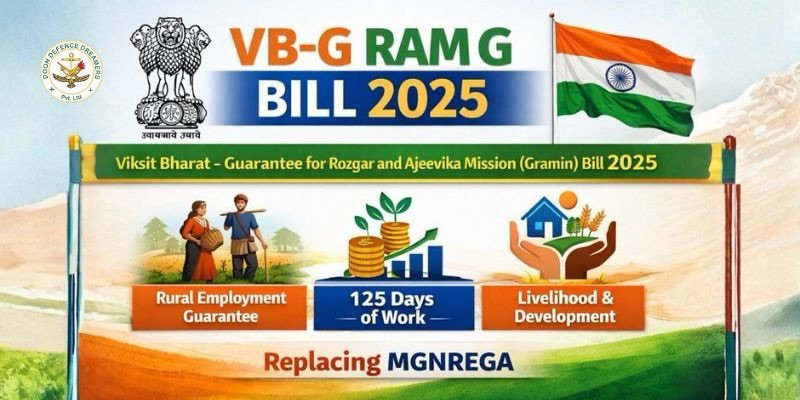
<p class="s9">More fundamentally, the new Act reflects a necessary shift in India’s development thinking. MGNREGA ;was designed ;as a relief mechanism in a period of acute rural distress. Treating distress employment as a permanent feature of the rural economy risks ;normalising ;stagnation. VB GRAM G explicitly links ;short term ;employment with livelihood creation, skilling and productive asset formation. The shift from counting days of work to building sustainable ;ajeevika ;recognises ;a basic truth. Dignity flows not merely from ;employment but from income stability, productivity and upward mobility. A welfare system that refuses to evolve risks entrenching dependency rather than eliminating poverty.</p>


<p class="s9">Concerns about increased fiscal burden on states also collapse under scrutiny. Under the earlier framework, states routinely faced uncertainty due to delayed central releases, unplanned liabilities and retrospective cost sharing disputes. VB GRAM G introduces clearer fiscal ;roles, ;medium term planning and outcome linked funding. Predictability is the foundation of real fiscal federalism. States gain the ability to plan rather than firefight. That strengthens administrative autonomy instead of weakening it.</p>


<p class="s9">Similarly, allegations of excessive ;centralisationconfuse national standard setting with micromanagement. In a ;programme ;of this scale, uniform benchmarks for transparency, eligibility and monitoring are essential. Local institutions continue to identify works, execute projects and supervise delivery. What has changed is the insistence on performance and accountability. ;Decentralisationwithout oversight has historically benefited intermediaries more than workers. VB GRAM G attempts to correct that structural flaw.</p>


<p class="s9">The most emotive criticism concerns the removal of Mahatma Gandhi’s name from the legislation. This argument substitutes symbolism for substance. Gandhi’s economic philosophy ;emphasisedproductive ;labour, ;self reliance, ;decentralisedgrowth and moral responsibility. Preserving his name while tolerating systemic inefficiency does not ;honour ;that legacy. A ;programme ;focused on durable community assets, local enterprise and livelihood sustainability aligns far more closely with Gandhian principles than one that treats subsistence work as an end in itself.</p>


<p class="s9">Reform inevitably provokes resistance, especially when it disrupts entrenched political narratives. ;Butsocial policy cannot remain frozen in time. India’s demographic pressures, fiscal constraints and development ambitions demand ;instruments that deliver measurable results. VB GRAM G represents a deliberate attempt to move rural employment policy from an input driven entitlement to an outcome-oriented guarantee. The transition will require vigilance, course correction and disciplined implementation. ;But ;resisting reform altogether would be the greater failure.</p>


<p class="s9">The real choice before policymakers is not between compassion and efficiency, or between rights and reform. It is between a welfare architecture that adapts to changing realities and one that clings to legacy frameworks long after their limits are exposed. VB GRAM G signals an evolution in thinking. It seeks to convert public expenditure into durable rural prosperity. That ambition, not political nostalgia, should define the national debate.</p>


<p class="s10"> ;</p>


<p class="s13">About author: ;Nirwa ;Mehta is a political analyst and columnist who writes on public policy, governance and national security. Her work focuses on power structures, state ;behaviour ;and the long-term consequences of policy choices in India and beyond.</p>

From Entitlement to Outcomes: The Case for Replacing MGNREGA with VBGRAM-G