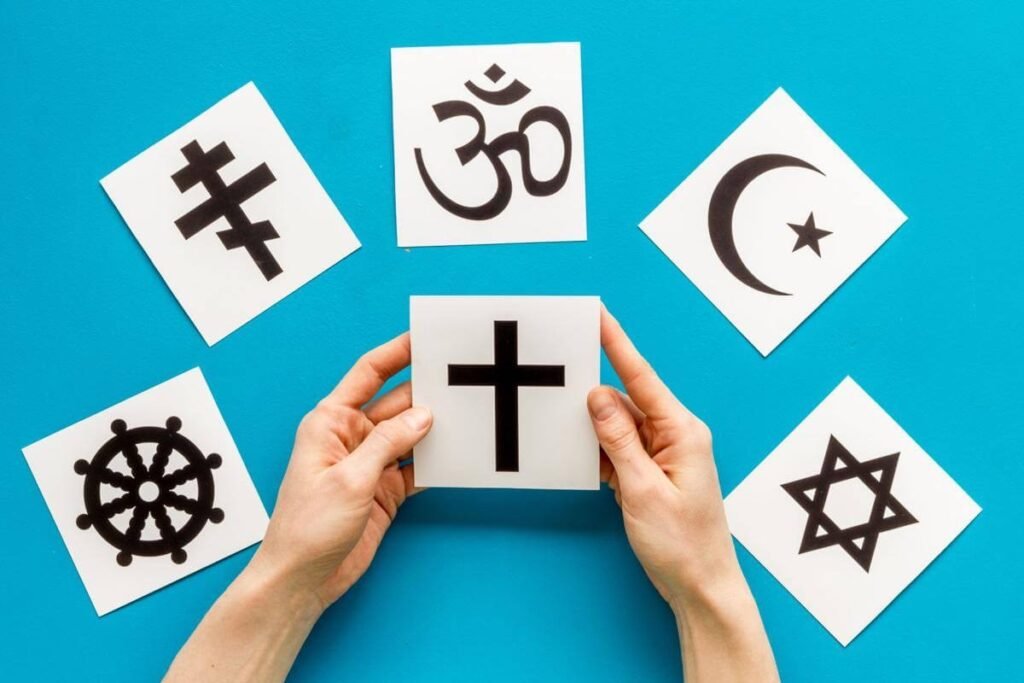


<p>India has never been a civilisation built upon monotony. It is a land where countless faiths, languages, customs and traditions have coexisted for centuries and shaped a unique civilizational ethos rooted in accommodation rather than exclusion. From the ancient teachings of Emperor Ashoka, who advocated respect for all sects after the Kalinga war, to the inclusive spiritual traditions of saints like Kabir and Guru Nanak, India&#8217;s history reflects a continuous dialogue between faith and collective belonging. The idea of India was never meant to erase religious identity; rather, it sought to harmonise diversity within a shared national consciousness.</p>


<p>In contemporary times, however, questions surrounding religion and nationalism have become increasingly sensitive. Public discourse is often polarised by political rhetoric, misinformation and social media narratives that attempt to portray religious identity and national loyalty as contradictory. Such binaries weaken the very foundation upon which modern India was built. The Indian Constitution, framed under the leadership of visionaries like B. R.<br />Ambedkar, consciously rejected the idea of a monolithic nation and instead guaranteed every citizen the freedom to practice, profess and propagate religion while remaining equal participants in the democratic framework of the country.</p>


<p>The challenge before India today is not to choose between religion and nationhood, but to ensure that both coexist in a manner that strengthens social harmony, constitutional morality and national unity. India&#8217;s syncretic culture offers precisely that path. The Indian understanding of nationhood has historically differed from rigid notions of identity seen in many parts of the world. Indian civilisation evolved through cultural exchange, migration and spiritual interaction.<br />Ancient trade routes brought Jews, Christians and Zoroastrians to Indian shores long before many modern nation-states came into existence. Instead of persecution, these communities found acceptance and protection. The arrival of Islam further enriched India&#8217;s cultural landscape through architecture, music, literature, language and spirituality. The emergence of the Ganga-Jamuni tehzeeb in northern India symbolised this blending of traditions, where people of different faiths participated in each other&#8217;s social and cultural lives.</p>


<p>The Bhakti and Sufi movements played a transformative role in nurturing this spirit of coexistence. Saints such as Moinuddin Chishti, Nizamuddin Auliya and Kabir preached compassion, humility and devotion beyond rigid communal boundaries. Their teachings resonated with ordinary Indians because they emphasised humanity over division. Even during the freedom struggle, leaders from different religious backgrounds stood together against colonialism. Mahatma Gandhi repeatedly asserted that religion should guide moral conduct, not fuel hatred. Similarly, leaders like Maulana Abul Kalam Azad argued that being deeply Muslim and deeply Indian were not conflicting identities but complementary ones.</p>


<p>Independent India institutionalised this vision through constitutional safeguards. Articles 25 to 28 of the Constitution guarantee freedom of religion, allowing every citizen to follow and practice their faith freely. Simultaneously, Articles 14, 15 and 16 ensure equality before law and prohibit discrimination based on religion, caste, sex or place of birth. The Constitution thus creates a balance where religious identity is respected, but citizenship remains the common binding force. Importantly, constitutional remedies under Article 32 empower citizens to approach the Supreme Court whenever fundamental rights are violated, making constitutional protection not merely symbolic but enforceable.</p>


<p>Yet constitutional guarantees alone are insufficient unless society collectively nurtures trust and empathy. Contemporary India faces the challenge of rising communal suspicion amplified by digital misinformation, selective historical interpretations and political polarisation.<br />Religious identities are sometimes used for electoral gains, reducing citizens to communal categories instead of recognising them as equal stakeholders in the nation&#8217;s progress. Such tendencies threaten the social fabric that has historically distinguished India from exclusionary<br />societies.</p>


<p>At the same time, there are countless examples that continue to reaffirm India&#8217;s composite culture. Across the country, Hindus participate in Eid celebrations, Muslims distribute langar during Gurpurabs, Sikhs protect temples and mosques alike during times of crisis, and Christians run educational and healthcare institutions that serve people irrespective of religion. During natural disasters and national emergencies, ordinary Indians repeatedly demonstrate that compassion transcends religious boundaries. The Indian armed forces too remain a powerful example of unity in diversity, where soldiers from different faiths defend the same tricolour with equal commitment.</p>


<p>For Indian Muslims in particular, the debate around national belonging often carries additional scrutiny. However, Indian history itself offers a strong rebuttal to divisive narratives.<br />From freedom fighters like Maulana Azad and Ashfaqulla Khan to scientists like A. P. J. Abdul Kalam, Indian Muslims have made immense contributions to nation-building. Their participation in education, defence, science, arts and public service reflects an inseparable bond with the nation. Patriotism in India has never required abandoning religious identity; rather, it has demanded commitment to constitutional values, social harmony and collective progress.</p>


<p>The true strength of India lies in its ability to accommodate multiple identities simultaneously. A person can be proudly religious and proudly Indian at the same time. The Constitution does not ask citizens to erase their beliefs; it asks them to uphold justice, liberty, equality and fraternity. These values are not opposed to faith. In fact, most religious traditions advocate compassion, honesty and coexistence as principles that strengthen democracy rather than weaken it.</p>


<p>India&#8217;s future depends upon preserving the delicate yet powerful balance between religious identity and national belonging. The country&#8217;s civilizational journey demonstrates that diversity has never been its weakness; it has always been its greatest strength. Attempts to force uniformity upon such a plural society risk damaging the very spirit of India. National unity cannot be built through fear or suspicion; it must emerge from mutual respect, constitutional trust and shared responsibility.</p>


<p>The Indian Constitution provides the legal framework for this coexistence, but sustaining it requires moral courage from citizens, intellectual honesty from leaders and sensitivity from institutions. Schools, media platforms, religious leaders and civil society must work collectively to promote dialogue instead of division. The need of the hour is not competitive nationalism, but compassionate citizenship rooted in constitutional values.</p>


<p>India&#8217;s syncretic culture; shaped by centuries of coexistence remains its most valuable inheritance. In an age marked by polarisation across the world, India can continue to stand as a model where faith and nationhood do not collide but coexist harmoniously. To be truly Indian is not to reject one&#8217;s religious identity, but to embrace the larger idea that unity is possible even amidst profound diversity.</p>


<p>-Insha Warsi<br>Francophone and Journalism Studies,<br>Jamia Millia Islamia.</p>

Balancing Religious Identity with National Belonging: The Indian Way Forward