
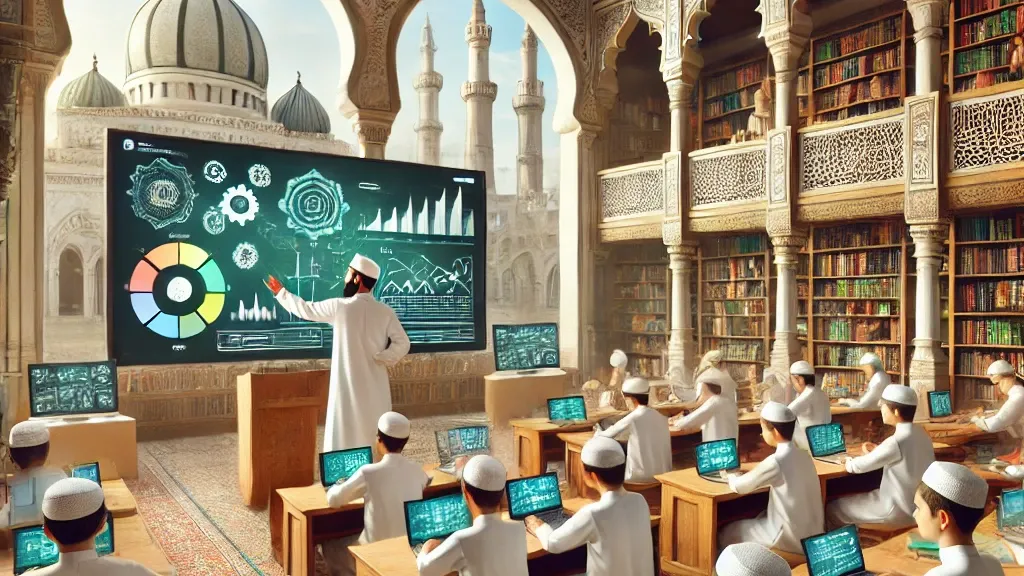
Education has always been one of the strongest instruments of community transformation. It gives a child confidence, provides families with economic opportunity and enables a society to participate more effectively in the development of the nation. For the Muslim community, there is an opportunity to take this educational journey one-step further by making two of its most trusted institutions, the mosque and madrasa, important centres of a modern educational movement.
The idea does not mean changing the fundamental religious character of these institutions. Rather, it means using their existing reach, trust and community presence to create additional opportunities for learning. A mosque can remain a place of worship while also becoming a centre where children receive guidance about education, digital literacy, careers, scholarships and responsible citizenship. A madrasa can preserve religious learning while gradually creating stronger pathways towards mathematics, science, languages, computers, vocational skills and higher education.
Such an approach has a strong foundation in Islam. The first revelation of the Qur’an began with the command, “Read in the name of your Lord who created” (Surah Al-Alaq 96:1). The first message therefore placed learning at the heart of the Islamic intellectual tradition. The Qur’an also teaches believers to pray, “My Lord, increase me in knowledge” (Surah Ta-Ha 20:114). Education should consequently be viewed not simply as a means of obtaining employment but as a lifelong process of developing wisdom and serving humanity.
Historically, mosques played an important role in the intellectual development of Muslim societies. They were not merely places where people gathered for prayer. They became places where scholars taught, students studied and knowledge were exchanged. The mosque and educational institutions were often closely connected. This historical experience offers an important lesson for the present: religious institutions can become powerful centres of learning without losing their spiritual identity.
In contemporary India, however, the meaning of education has expanded enormously. Children need literacy and numeracy, but they also need computer skills, English and other languages,
scientific understanding, financial awareness, digital literacy, critical thinking and career guidance. Young people must understand how to apply for scholarships, competitive examinations, vocational programmes and employment opportunities. Parents also need information about educational pathways available to their children.
After or outside regular prayer activities, suitable spaces associated with mosques can host educational counselling sessions, reading rooms, digital-literacy classes, and career-awareness programmes. Volunteers and qualified professionals from the community can conduct sessions on subjects such as computers, English speaking, mathematics, science, financial literacy and preparation for competitive examinations.
A young person who enters a mosque for prayer could also find
information about scholarships,
government skill-development
programmes or opportunities for higher education. Parents who traditionally approach religious institutions for guidance could receive information about the importance of keeping children in formal education and helping them choose suitable academic and vocational pathways.
The madrasa can play an equally important role. Religious education and modern education need not be treated as mutually exclusive. A madrasa student can study Qur’an, Hadith, Islamic history and ethics while also developing competence in mathematics, science, languages, computers and social sciences. With appropriate curriculum planning, teacher training and academic partnerships, madrasa education can help students preserve their religious learning while acquiring skills required for the modern economy. This is not about replacing religious education with secular education. It is about expanding opportunity.
The Qur’an asks, “Are those who know equal to those who do not know?” (Surah Az-Zumar 39:9). Knowledge, from an Islamic perspective, carries a responsibility. It should make a person more capable of understanding the world, distinguishing truth from falsehood and contributing to the welfare of others. The Prophet Muhammad also encouraged the pursuit of knowledge. Sahih Muslim records that whoever follows a path in search of knowledge, Allah makes a path to Paradise easy for that person (Sahih Muslim 2699). This provides a powerful moral foundation for creating educational opportunities within community institutions.
Teachers and religious scholars can become important leaders in this transformation. An imam who encourages parents to educate their daughters and sons, a madrasa teacher who motivates students to study science, or a community scholar who guides young people towards higher education is contributing to community development in a very practical way. The potential benefits are substantial. A network of community-based learning centres could help children who need additional academic support, provide adults with digital skills, guide young people towards employment and entrepreneurship, and encourage parents to invest more strongly in education.
It could also help reduce the distance between the community and the wider education system. Career counselling camps could introduce students to universities, professional courses, scholarships, government examinations and vocational opportunities. Alumni networks could connect successful doctors, engineers, teachers, entrepreneurs, civil servants and other professionals with students seeking guidance.
Women and girls should be an integral part of this educational movement. Appropriate and culturally sensitive arrangements can provide girls and women access to digital literacy, vocational education, language learning, entrepreneurship and career guidance. Educating women strengthens not only individual families but also the educational environment of the next generation.
Importantly, this transformation should be based on quality rather than symbolism. Not every mosque or madrasa needs to become a full-fledged school. Different institutions can adopt different models according to their capacity. One may operate a small library, another a computer centre, another an evening tutoring programme, while a larger madrasa may establish formal academic partnerships. The guiding principle should be simple i.e. use existing community trust and infrastructure to expand access to beneficial knowledge.
This approach can also strengthen national integration. Education creates opportunities for young people to participate confidently in India’s social and economic life. The Quran reminds humanity that diversity exists “so that you may know one another” (Surah Al-Hujurat 49:13). An educated community is better equipped to engage with people of different backgrounds, understand constitutional responsibilities, participate in public life and contribute to national development. The mosque and madrasa can therefore become more than places where knowledge is preserved. They can become places where knowledge is applied.
An education revolution does not necessarily require building new institutions everywhere. Sometimes it begins by reimagining the institutions a community already trusts. If mosques and madrasas become gateways to both faith and beneficial modern knowledge, they can help create a generation that is spiritually grounded, intellectually confident, professionally capable and socially responsible. That would be a meaningful expression of the Islamic principle that knowledge should not remain confined to books. It should illuminate lives, open opportunities and ultimately become a source of benefit for humanity.
-Insha Warsi
Francophone and Journalism Studies,
Jamia Millia Islamia.