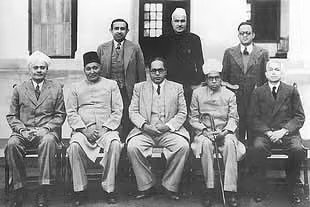


<p>The making of the Indian Constitution was not merely a legislative exercise, it was a moral contract among diverse communities, stitched together through the shared suffering of colonialism and the shared dream of a sovereign, inclusive nation. At a time when the subcontinent stood at the crossroads of division and unity, several Muslim leaders chose the path of constitutional democracy over communal separation. These visionaries, seated in the Constituent Assembly, helped shape a legal framework that enshrined secularism, justice, and equal rights. Far from being passive participants, they were active architects of a modern, plural India. Their contributions remind us that the idea of India was never shaped by any single faith or ideology but by a coalition of minds committed to liberty and unity.</p>


<p>The most prominent among these visionaries was Maulana Abul Kalam Azad, a scholar, freedom fighter and the first Education Minister of independent India. His presence in the Constituent Assembly was both symbolic and substantial. A devout Muslim and a staunch nationalist, Azad had long rejected the two-nation theory. In speech after speech, he reiterated that India&#8217;s destiny could not be built on religious segregation but on shared history, mutual respect, and a common future. Azad&#8217;s intellectual gravitas and deep commitment to secular values influenced many key provisions of the Constitution. He strongly supported Article 25, guaranteeing religious freedom, and Article 30, protecting the rights of minorities to establish and administer educational institutions. More than just constitutional clauses, these were moral assurances particularly to the Muslims who had chosen to stay in India after Partition</p>


<p>Azad also played a pivotal role in shaping India&#8217;s educational policy. As the Education Minister, he laid the foundation for the University Grants Commission (UGC), the Indian Institutes of Technology (IITs), and the promotion of scientific temper and modern education across castes and communities. For him, the progress of a nation rested not just on constitutional ideals but on enlightened citizens. He once famously said, &#8220;Education imparted by heart can bring revolution in the society.&#8221;</p>


<p>Another important Muslim figure in the Constituent Assembly was Begum Aizaz Rasul, the only Muslim woman to be part of this historic body. Her presence alone challenged stereotypes and broke barriers in a deeply patriarchal society. Begum Rasul was an ardent advocate for gender rights and minority protections. Her voice strengthened the resolve to build a unified electoral system, which remains the backbone of India&#8217;s democratic process today.</p>


<p>Syed Mohammad Saadullah, a former Premier of Assam, was another key figure whose insights helped balance federal and minority interests. His interventions in the debates on citizenship and minority safeguards reflected a mature understanding of India&#8217;s plural nature. He insisted on legal equality and social cohesion, advocating not for privileges but for protections that would allow every Indian regardless of religion to thrive.</p>


<p>These Muslim leaders were not isolated voices. They were part of a larger ecosystem of Muslim patriotism that rejected the idea that religion should dictate national loyalty. In the years leading upto and following independence, organisations like the Jamiat Ulama-e-Hind and individuals like Khan Abdul Ghaffar Khan (though not in the Constituent Assembly) strongly supported India&#8217;s unity and constitutional values. Their collective presence was a rebuttal to communal propaganda and a reaffirmation of faith in India&#8217;s democratic future.</p>


<p>As we reflect on the making of the Indian Constitution, we must remember the Muslim leaders who stood at the forefront of its creation, not as representatives of a community, but as visionaries of a nation. Their legacy is not merely etched in the pages of the Constitution but lives in the rights and freedoms we enjoy today. These stories remind us that the foundations of modern India were laid by hands of all faiths. The Constitution is not just a legal document, it is a testament to the courage, foresight and patriotism of men and women who chose unity over division. And in that sacred assembly, the Muslim voice did not speak from the margins, it echoed from the heart of India.</p>


<p>-Insha Warsi</p>


<p>Francophone and Journalism Studies,u</p>


<p>Jamia Millia Islamia.</p>